MakerBloks Launches Four New Games, Including iOS App

MONTREAL, May 12, 2015 /PRNewswire/ — Today, MakerBloks introduces four new games, including a new iOS tablet app, to empower the next generation of makers and inspire STEM education. With MakerBloks, more than 40 million children across North America can now create, build and design real electronic circuits, without any prior technical knowledge.

MakerBloks Logo / MakerBloks Launches Four New Games, Including iOS App (PRNewsFoto/MakerBloks)

MakerBloks are reactive color-coded, magnetic blocks that guide children through the basics of electronic circuits in a simple, fun and immersive way. To keep kids engaged, MakerBloks is introducing four games to pre-order on Kickstarter, including:

  • Light and Sound Intro Kit – featuring the basics to building circuits
  • Music Kit – featuring keyboard, microphone and flute games
  • Spy Kit – featuring voice changing and burglar alarm games
  • MakerBloks World – an interactive tablet game that combines the virtual and physical worlds

MakerBloks World is a state-of-the-art tablet game that combines the virtual and physical worlds. The tablet’s front camera uses unique MakerBloks visual recognition software to read and react when a child assembles the blocks correctly, all in real-time. With MakerBloks World, the child advances through an educational game that uses puzzles, rocket launchers, and imaginative settings such as candy land, water world and outer space, creating a truly immersive way to teach kids how to build and use electronic circuits.

„With over 15 years specializing in designing children’s games and toys, I understand how games should look, function and feel,“ saidFrancois Poirier, CEO and founder of MakerBloks. „I also know how important longevity is. Parents want their kids to use games and toys for as long as possible. The best part about MakerBloks is its ‚hack-ability‘ – the instructions are just the beginning. Teaching kids about science and technology is a great start, but helping them to be more resourceful, more creative and to feel empowered is what MakerBloks is really about.“

Founded in 2014, MakerBloks was inspired while Francois was shopping for a game or toy for a six year old that was fun, easy-to-use and educational. Since everything was either too complex or had no educational component, MakerBloks is designed for children starting at six years old. Each kit features:

  • Colorful blocks that magnetically connect together on all four sides
  • A guide that explains what each block’s electronic symbol means
  • A set of instructions that is optional! Follow the instructions or troubleshoot your way to success!
  • A hacking hint: every game can be assembled multiple ways – the possibilities are only limited by your imagination

MakerBloks is available for pre-order today on Kickstarter, with intro kits starting at $45 and advanced kits, including intro kit and additional blocks, begin at $85. The MakerBloks iOS tablet app will be available for download once the kits begin to ship in Fall 2015.

For more information about MakerBloks, please visit http://makerbloks.com/en

About MakerBloks

Francois Poirier founded MakerBloks in 2014 after he realized that there are no simple ways to teach young children about electronics. Pairing beautiful design with functionality and fun, MakerBloks gives parents the tools to set their child up for successful learning in science, technology, engineering and math. Easily identified and connecting flawlessly every time, MakerBloks start with a battery, but are powered by imagination.

Loughborough University Science and Enterprise Parks partnership helps launch MeArm – a mini robotic arm for the masses

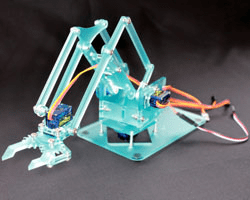
A pocket size robot arm to make robotics, electronics and programming accessible to the masses has smashed its Kickstarter goal.  A miniaturised version of an industrial robot arm, MeArm is simple enough to build and use with primary school children, but also enables advanced levels of robotics education.

Being open-source, MeArm’s entire design and code files are freely available to download so that makers everywhere can share and enrich their knowledge. There are already well over 250 MeArms ‘in the wild’ in every continent except Antarctica.

MeArm can be cut entirely from an A4 sheet of acrylic and built with standard low-cost servo motors. Kickstarter success will enable the launch of the MeBrain, an innovative platform that make it possible to build something low cost ‘with nothing but a screwdriver and enthusiasm’ from May 2015.

In order to bring robotics to the masses, MeArm’s founder and open source enthusiast Ben Gray sought the expertise of Des19ncor, a design consultancy based on Loughborough University Science and Enterprise Parks (LUSEP).

“We saw a great opportunity to help Ben create a viable long term business” said Martin Croft, Des19ncor’s MD, who has since registered MeArm as a new venture in LUSEP’s Innovation Centre.

In addition to the partnership with De19ncor, MeArm has also benefited from the creative expertise in the Studio, the University’s graduate commercialisation hub. Collaboration with the Department of Computer Sciences will strengthen the ultimate goal of MeArm’s widespread adoption by schools, colleges and universities to encourage STEM (science, technology, engineering and mathematics) education.

As support for MeArm builds, a stretch goal to upgrade kits to include hexagonal screws and tools has already been achieved and the project is well on the way to having a wireless support option. Further stretch goals have since been added, including Bluetooth support and app development. “It’s been fantastic to receive such an enthusiastic response for MeArm,” said Ben Gray.  He added, “With even more support, we could create an interface with the credit card-sized computer, Raspberry Pi which is already blazing a path into engagement in STEM education.”

Dynepic® to Launch Internet of Toys™ Platform & Debut Product on Kickstarter: 15 November

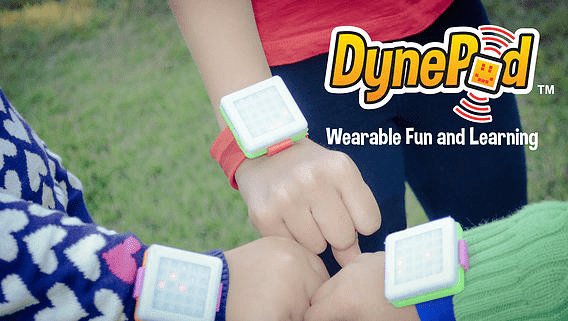
Dynepic® is pleased to debut the future of toys with our premier device, the DynePod™, which will launch 15 November on Kickstarter.com.  DynePods™ operate on The Internet of Toys™ (IoToys), Dynepic’s state-of-the-art open platform designed to share cloud content and connect toys, merging elements of child’s play and technology to enable children to interact with their toys in revolutionary and modern ways.

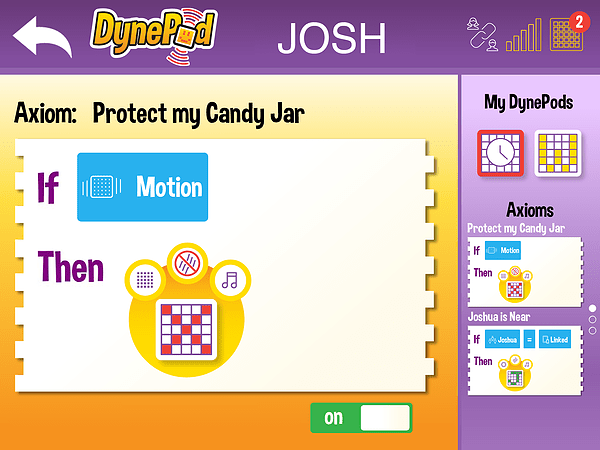
The DynePod™ is an educational, Bluetooth connected toy designed to introduce fundamental concepts of customization, socialization, programming and engineering, by allowing children to create their own interactive programs for their toys. Using a graphical If, Then programming interface, developed under contract with the National Science Foundation, children can create a multitude of unique, useful programs that involve both the digital and physical world.  DynePods™ are modular, fully customizable toys that are compatible with a multitude of self-designed and 3D printed accessories, encouraging the next generation to start innovating.  Enabled by the Internet of Toys™ platform, DynePods™ can morph and grow with the child through cloud updates, as well as connect wirelessly with other DynePods™ and a host of other future toys linked to the platform.

„DynePods™ and The Internet of Toys™ platform will enable new play patterns and encourage open-ended exploration for the future of toys, for children, makers, and toy inventors alike,“ Krissa Watry, Dynepic’s Co-Founder & CEO, comments.  „We hope you will join us by supporting DynePods™ and the Internet of Toys on Kickstarter, 15 November.“ For more information on how Dynepic is working to build the COOL aisle for toys, please visit our website www.dynepic.com or contact us at info@dynepic.com. A Press kit is available.

Founded in 2011, Dynepic® is focused on building cool connected toys and an open architecture and cloud platform to drive child friendly content in new and innovative ways. Dynepic® is a women owned, veteran owned, small business focused on creating the Internet of Toys™.  

15-foot-tall robots coming to a reality near you!

Boston-based engineers developing humanoid robots meant to be piloted by two people

BOSTON, MASS. — Three engineers are leading a team building fifteen-foot-tall, fighting humanoid robots in Boston, Mass., and they are asking the public for help to pull it off. It might sound like science fiction, but it’s not.
Experienced and talented engineers and entrepreneurs Andrew Stroup, Gui Cavalcanti and Matt Oehrlein have teamed up to turn these robots into reality. At the end of October, they will launch a Kickstarter campaign to take things to the next level.
“People keep asking us, ‘Why build giant fighting robots?’” said Andrew Stroup, Co-Founder of MegaBots, Inc. “Our answer is always, ‘Why not?’” All three were raised on video games, movies and science fiction stories that included giant robots, and decided that it was time to turn their skills to good use.
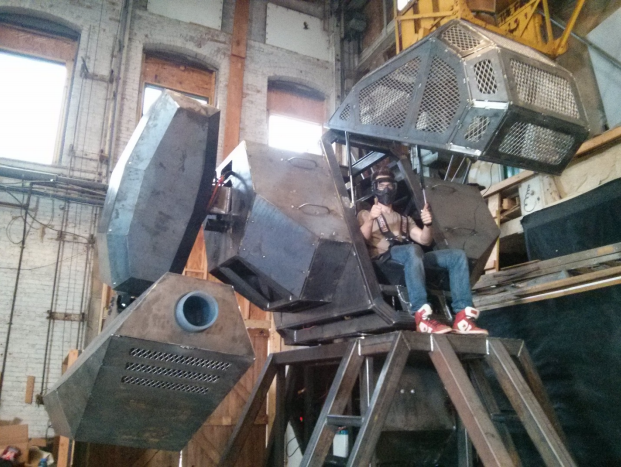
Since the start of summer, they have built a fully functional torso, cockpit, arm, and two main weapons system of a MegaBot. The cockpit seats two adults, a driver who controls the robot’s movements and the gunner who commands the weapons systems.
„Having the MegaBot aim its cannon at you is a heart-stopping experience,” Gui Cavalcanti, Co-Founder 
of MegaBots, Inc. described. “Even if you know it’s not loaded. Here’s this gigantic, armored humanoid robot three times taller than you are, smoothly and quietly lining up its sights on you – it’s downright terrifying.“
The MegaBots team has completed parts of the dream. Soon, they will ask the public for help with the launch of a Kickstarter campaign. 
“There’s no doubt we want to bring MegaBots to the masses,” Matt Oehrlein, Co-Founder of MegaBots, Inc., proclaimed. “We want to know they want it to happen as bad as we do.”

PBL ROBOTS dice & card game

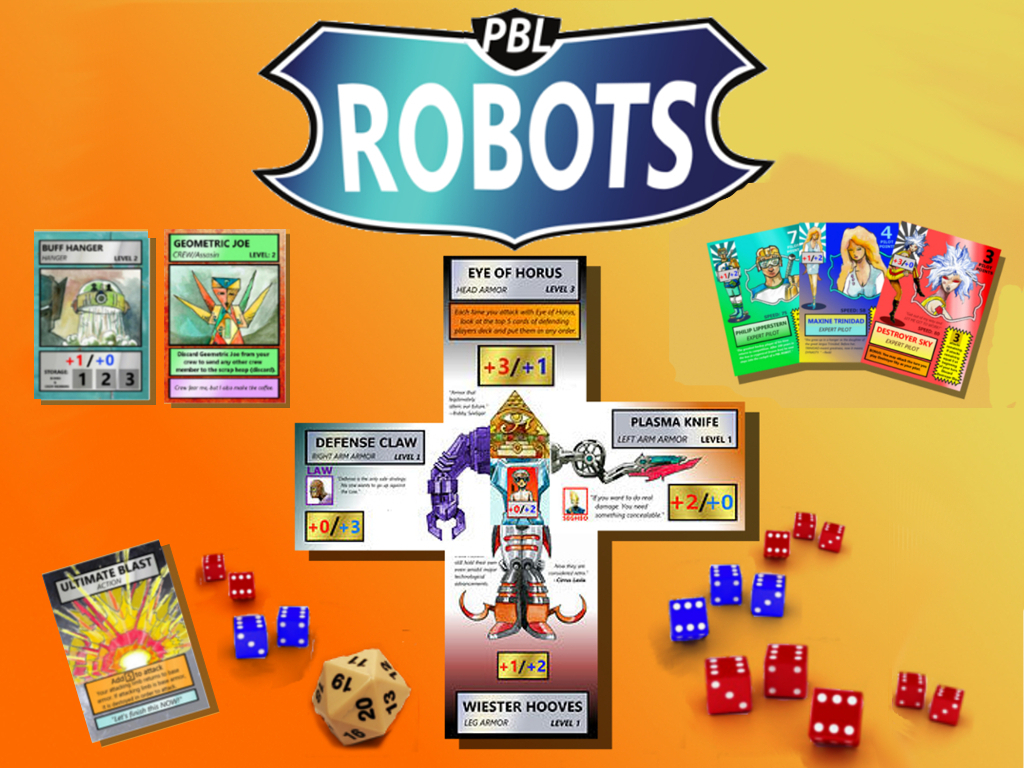
William Hessian and John „Sighless“ Supinski have spent the last year creating a brand new strategy card and dice game called PBL ROBOTS! „The game is a interesting mix of Risk and Magic the Gathering, except this game has giant 100 foot Robots!“ William said. The card game challenges each player to collect cards in a draft format in order to build their deck. When the battle begins each player slide their pilot card into the robot card, courtesy of a die cut cockpit in the center of the robot. Then players lay armor cards on the robot to watch the robot grow stronger and boost up the attack and defense. When players start attacking they roll dice to determine if the robot will blow of an arm, a leg or a head. Each pilot has a powerful critical form when you are down to one remaining limb, which gives the losing player a chance to make a comeback, but when a robot has lost of four limbs the game is over.

William and John have spent their free time at their apartment on the East End of Portland, Maine developing this intense card game consisting of 113 unique cards and 3 different game play modes. William is a local visual artist and activist, working at Preble Street, teaching at Rivertree Art in Kennebunk and volunteering at the Meg Perry Center. William did all of the artwork and design for the game and originally invented the concept for the game over ten years ago in Minnesota, but did not start finishing it until meeting Sighless in 2012. Sighless is a local musician in the Bumbling Woohas and works at the Maine People Alliance, and was the host of Turnstyle Thursday open mic at CTN Channel 5 for over a year. Once Sighless began working on the game he created a business plan, invented characters and began writing back stories. A group of artists called the Hidden Ladder Collective, which William and John helped start, began play testing the game in-between hosting art shows, art making gatherings and busking out on the streets. Other members of Team Robots, Abbeth Russell and Kara Oster made important contribution to the game.

Thursday, October 23rd the collective has launched the Kickstarter hoping to raise the $22,000 they need to print the first edition versions of the game. As of November 1st they have raised $7,000 towards their goal. Over 100 letters have gone out to game stores across the country. William and Sighless and PBL ROBOTS fans have been playing PBL ROBOTS demo events weekly at R Choice 2 Gaming Thursday Nights which is a free event open to the public. The group has been travelling to Louisana, New Orleans and the Midwest to demo the game.

While the game itself is optimal for players 12 years and older, due to the high level of strategy, the game is also very appealing to a younger audience. William teaches art at Rivertree Arts in Kennebunk and his 4th to 6th grade students have loved the PBL ROBOTS cards. „The kids come back the next day demanding to have another glance at the game, and their parents follow right behind curious to see what the kids are so excited about,“ William remarked. Because of the kids persistence William and Sighless invented a new way to play the game that makes it a little easier for a younger audience, but retains the fun and excitement of the longer game. The popularity of the game is already growing with over 900 Twitter followers and over 200 Facebook likes.

To check out their Kickstarter visit their website at: https://www.kickstarter.com/projects/robotcardgame/pbl-robots-dice-and-card-game (started at 7pm Thursday 10/23). The group is hoping to play the game with as many new players as possible all around the country while hoping to hit their goal by December!

AeriCam Releases the Anura; a Revolutionary Pocket Size Drone.

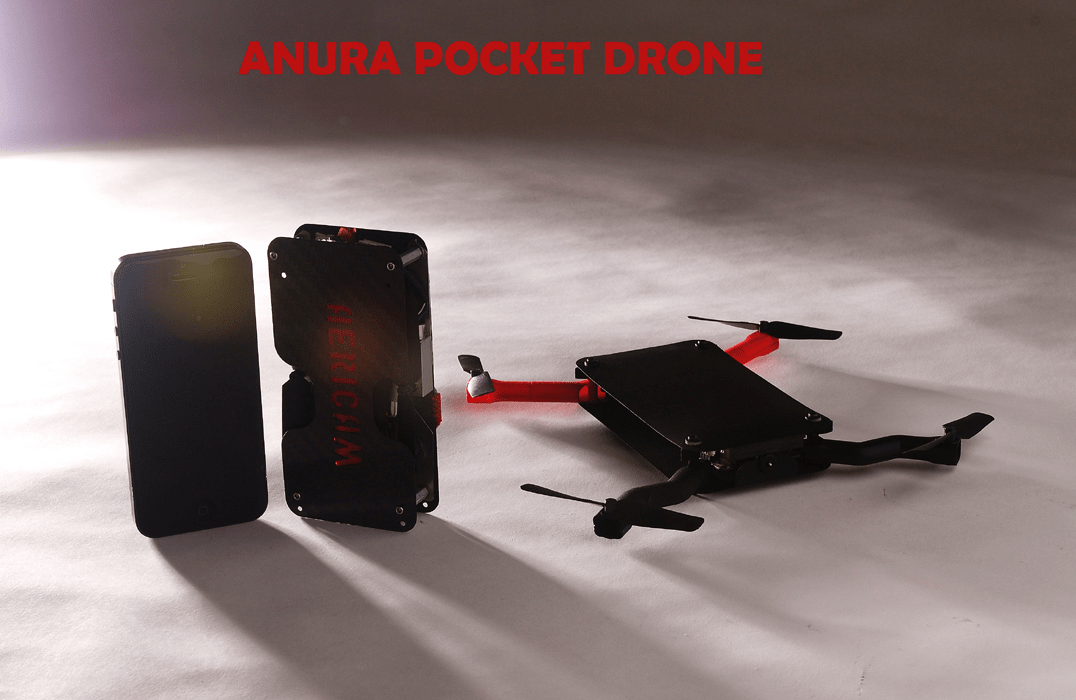
The Anura is AeriCam’s game changer for the drone consumer market.  Anura is a mini drone that’s designed to fit in pants or shirt pockets, with all sensitive parts protected. Your smart phone is the only thing you need to operate the Anura.

The Anura is the first drone in the consumer market to travel with the user 24/7, whenever and wherever. This allowing users to never miss a moment; capturing aerial photo and video. It is user friendly, so one can simply enjoy the thrill and freedom of flying.

The Anura was designed to inspire people who are interested in flight, photography, videography, or just to entertain. Anura is controlled via Wi-Fi to your smart phone (IOS/Android), and through the App. You can fully control the aircraft’s direction. Anura features a micro camera and the view of the camera is streamed through Wi-Fi to your smart phone; which allows you to capture the exact photo and video from the App. Anura also features functions such as auto take off, auto land, return home, and follow the phone; which makes it one of the most powerful and versatile mini drone of its class.

AeriCam is a San Francisco based company established for developing aerial cinematography solutions. The company has designed drones and camera equipment for six years, and combines a strong technical expertise with a long history of delivering professional and reliable equipment.  The Anura is AeriCam’s first consumer product, but you can be certain it will share the same traits as their professional line.

Anura will be available for pre-order through Kickstarter, and you can check updates and product launch information on www.AeriCam.com.

Rico – Turn your used smartphone into a smart-home security device

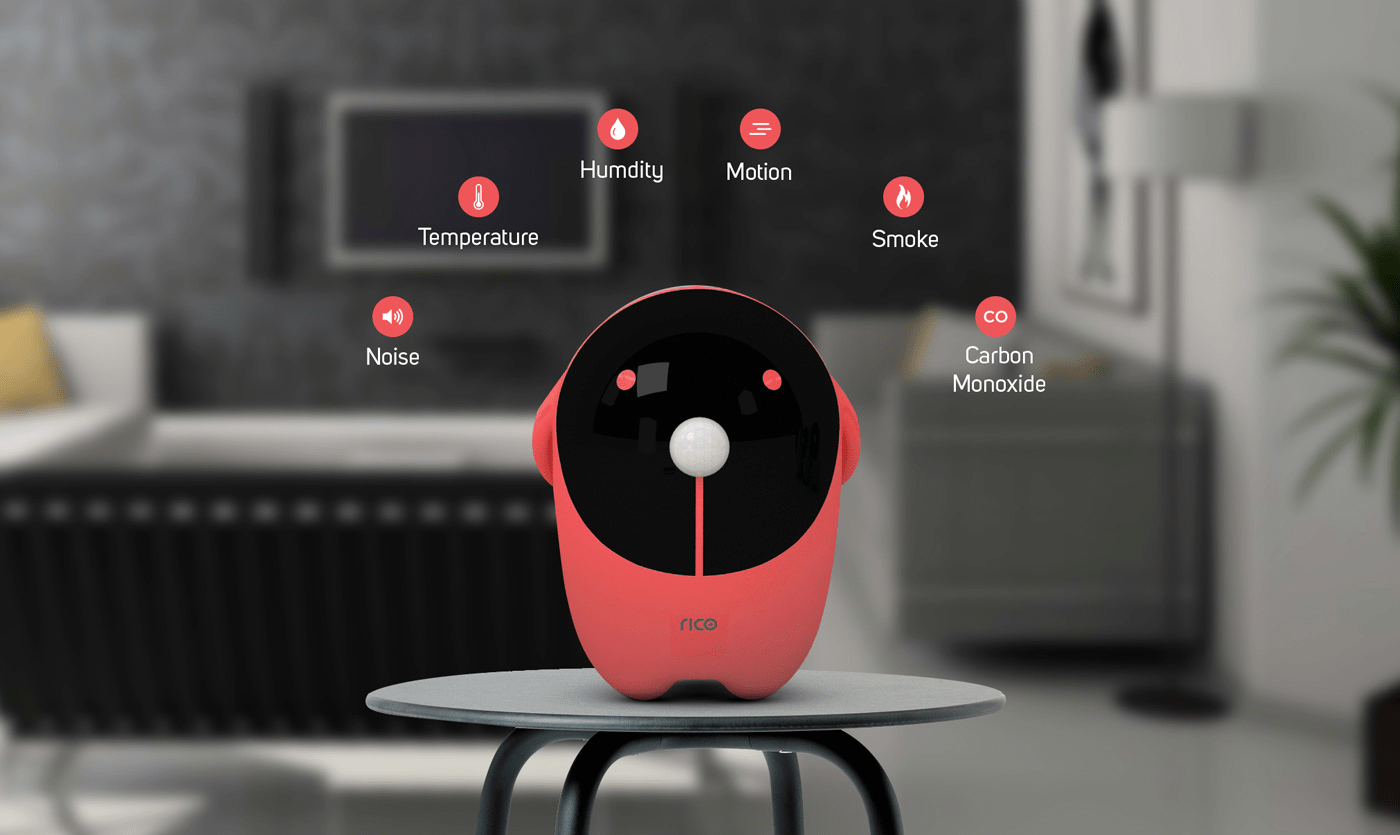
Rico is a smarthome security device that uses your old smartphone as its brain and eyes. We took away the clutter of heavy and expensive home security hardware and replaced them with an old smartphone. All you need to do is install an App into your old smartphone, insert it into Rico, turn it on, and your smarthome security companion is ready.

Rico has just launched on Kickstarter

Kallidil Kalidasan, the CEO of MindHelix, Inc which created Rico says, “Smartphones are really powerful devices with HD cameras, microphones, 3G and WiFi connectivity and a powerful processor. Rico takes these capabilities and uses them to transform your home into a smarter, secure home at an affordable price point.”

Users connect with their Rico through the Rico App which will be available across all major smartphone platforms. Rico comes equipped with photo electric sensors that detect the slightest changes in your home like temperature, humidity, motion, carbon monoxide, smoke, natural gas, noise levels etc. It will immediately alert you when something goes wrong and you can even watch live video of your living room with Rico App. Rico also comes with smart power sockets which can control your appliances using the Rico App from anywhere.

Whilst Rico is an effective solution to home security, Kali points out that the product is trying to solve a much bigger problem. “We love how cute Rico is. But the reality of how many smartphones are wasted is not so cute. So we decided that this would be a focus for us when we began the project. It turns out that we have created not just a viable alternative use for your old smartphone, but an industry-disrupting product. Because of this, we truly believe it is going to take the world by storm.”

He is right. For the average consumer, the shelf-life of a smartphone is 24 months. According to IDC, of the over 280 million smartphones that were sold last year, many will be replaced without being recycled. These phones are toxic to the environment, polluting the air and contaminating soil and water with metals and plastics. What’s worse is that over 90% of these will be in perfect working order.

With Rico, MindHelix aims to disrupt the smart-home market and then encourage us to rethink how we consume electronics. The company plans to open up developer APIs for Rico, allowing developers around the world to create a community and help Rico grow. Kali says “We’ve developed working prototypes of Rico and we need your help to bring Rico to market. We want to solve the problem of used smartphones creating a huge environmental impact. Rico helps consumers repurpose them for something as cool as a smart home solution”.

Rico is a product from Mindhelix, Inc a Bay Area based startup which was part of the batch 3 at the Alchemist Accelerator program.

Rico is now raising $100,000 on Kickstarter and has already chalked up 30% of its target in the first week. Kickstarter page here : http://kck.st/1pmEqzN

Scratchduino is going to Kickstarter!

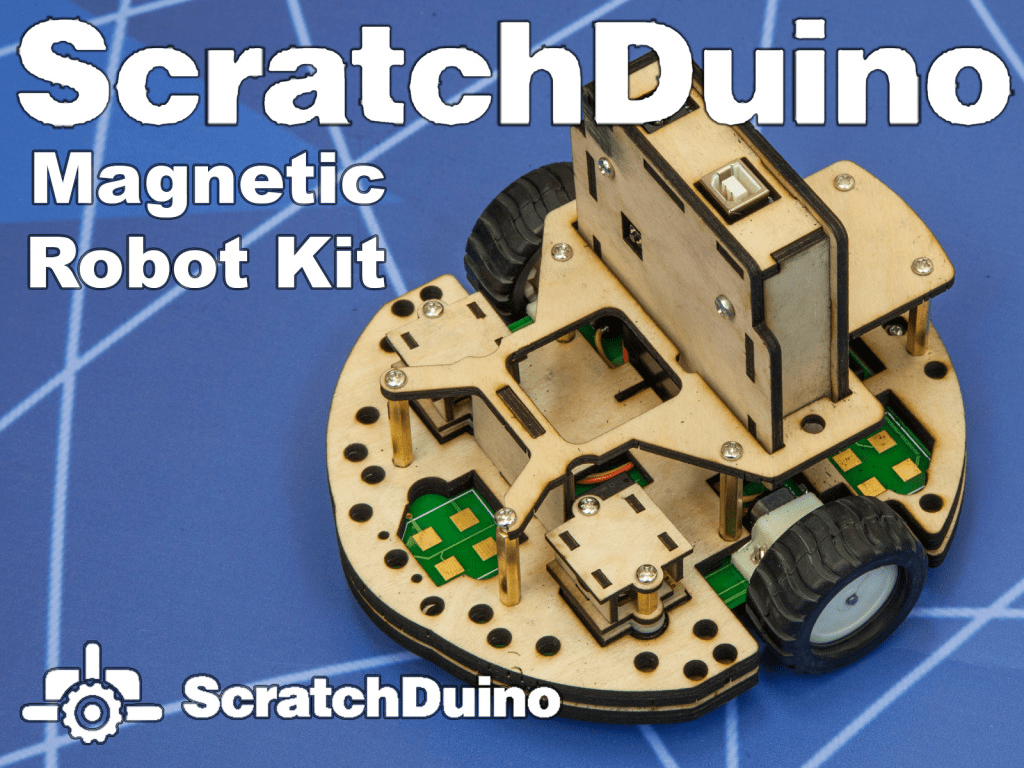
ScratchDuino, the Programmable Magnetic Robots Construction Kit is going to Kickstarter.

Mezon.Ru, a winner of Google Rise Awards 2013 and 2014, is proud to announce the launch of  kickstarter campaign for their programmable magnetic robot kit ScratchDuino. The goal is to raise$105,000 by October 24, 2014, and to start the serial production of ScratchDuino robots construction kits in Finland.

Being completely open source, the ScratchDuino robots construction kit allows users to assemble robots utilizing the original set of parts, to modify their robots in a various ways, to program AI, and to share their modifications with STEM robotics community all over world.

Kickstarter project set of rewards includes the robot kit with different versions of body, educational class kit with master class included, all blueprints and assembly schematics (on usb flash and downloadable) for those backers, who would like to create ScratchDuino from scratch completely.

More information about the ScratchDuino robots construction kit can be found here: https://www.kickstarter.com/projects/scratchduino/scratchduino

Big September for STEM Toy Startup TROBO: Kickstarter Launch, ABC Kids Expo and Maker Faire Orlando


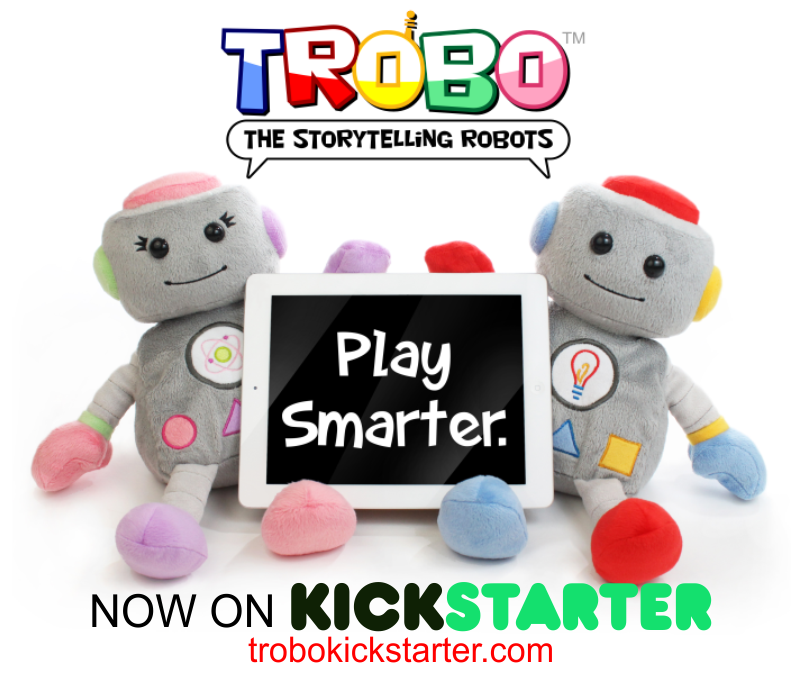
TROBO-NowOnKickstarter-2

ORLANDO, Fla. – It’s a big month for TROBO the Storytelling Robot as the company launches its Kickstarter campaign and participates in both the ABC Kids Expo in Las Vegas and Maker Faire Orlando.

Created by two dads, Jeremy Scheinberg and Chris Harden, TROBO is a huggable stuffed robot toy and storytelling app that answers kids’ questions about the science and engineering around them.

The plush storytelling robot, TROBO, uses an interactive storytelling app to read out loud and engage children ages 2-7 through an iPad. They currently have 2 characters…a male TROBO, Edison and a female TROBO, Curie.

“TROBO’s mission is more than just child’s play,” stated Scheinberg. “The goal is to get kids excited about science, technology, engineering and math (STEM) in the world around them through exciting and creative story lines that make the child the star of the story.”

TROBO’s Kickstarter campaign launched on Wednesday, September 3rd and raised 1/3 of their $60,000 goal in the first 24 hours. The campaign will fund the first round of manufacturing and complete development of the storytelling application. The campaign – which is accessible at www.TROBOkickstarter.com – aims to appeal to parents and grandparents looking for smarter toys for children.

The company will also be appearing at the ABC Kids’ Expo September 7-10 at the Las Vegas Convention Center where they were accepted into the show’s “Invention Connection” pavilion for innovative juvenile product startups. “We are really excited to meet with toy buyers from all over the world to get more feedback which will help us bring TROBO to market,” said Scheinberg. TROBO will be exhibiting at the show at booth #35 in the Invention Connection.

Rounding out a busy few weeks, the company will also be exhibiting at Maker Faire Orlando at the Orlando Science Center September 13-14. “We have had such great support from the Orlando community since we created TROBO. It will be great to show our product to people who have followed us since the beginning,” said Harden.

So how do two Central Florida fathers invent and prototype this amazing technology toy?
Scheinberg and Harden both have backgrounds in engineering and storytelling.

Jeremy Scheinberg was the Chief Operating Officer at Alcorn McBride, the leading manufacturer of audio, video and control products for themed entertainment with clients including NBC, Universal, Lego and Disney.

Chris Harden was a Development Director with EA Sports, managing the User Experience core technology group for the label and has a history in film and comics.

For more information visit www.HereComesTrobo.com

$40 robot has a shot at Kickstarter crowdfunding

Robotics company, Microbric has done the impossible by developing Edison a small
robot with an amazing array of sensors for under $40, making it the most affordable educational robot in the market. Edison was launched today on Kickstarter. This small yet feature packed robot is set to revolutionise how robotics and programming are taught in schools thanks to its easy to use drag and drop programming software, modular design and intelligent sensors that react to light, sound and remote commands. Its unique design and compatibility with LEGO products lends itself to creativity – the seed of fun robotics to inspire the inventors of tomorrow.

Edison was created to make robotics more accessible to students and hobbyists alike and is the brainchild of Brenton O’Brien, himself an electronics engineer with a passion for robotics. For over 10 years his company, Microbric, has been creating educational robots for hobbyists but his dedication to bringing robotics into mainstream education paid off when the Australian Curriculum changed in January to specifically include robotics within the Digital and Design streams.

‘I realised that my goal was within reach but that the main obstacle to bringing robotics into every classroom was the cost of buying kits for schools with already tight budgets. So I created Edison with the functionality of a much more expensive robot, at a fraction of the price,‘ Brenton said.

But, whilst Brenton’s dream may be within reach, it’s still not a reality until the funding goal on Kickstarter is met and the capital is raised to manufacture Edisons en masse.

Microbric’s Edison Kickstarter campaign seeks to raise $20,000 in 30 days via the crowdfunding website Kickstarter. If they meet their goal, the funds raised will foot the manufacturing bill of an initial production run of robots, which will then be sent to backers wherever they are in the world. If you’re interested in supporting Microbric’s campaign, visit the Meet Edison Kickstarter page. If you want to follow the journey of Edison from idea to reality, track the project’s progress on Facebook, Google+ and the Edison website (www.meetedison.com).

Crowdfunding is an increasing trend in fund raising for new initiatives. It involves the collection of finance from backers to fund a project. Crowdfunding is expected to completely transform venture capital over the next decade.

“We are launching Edison on Kickstarter because we wanted to give people the chance to be part of something that will change the way our children learn about robotics in mainstream education,’ Brenton said

“Now, every child in Australia can learn about robotics and the importance of technology to their future careers. I’m really excited about this launch and hope that parents and teachers alike will back Edison.’

Microbric is a small Adelaide based company which has worked with the Adelaide Advertiser newspaper in producing two collectable robots and initially selling its robots through Dick Smith Electronics. Now, creating all types of robots for over 10 years nearly 100,000 Microbric robots have been manufactured and sold in Australia and overseas. Microbric anticipates that Edison will be its most successful robot yet.

http://www.meetedison.com