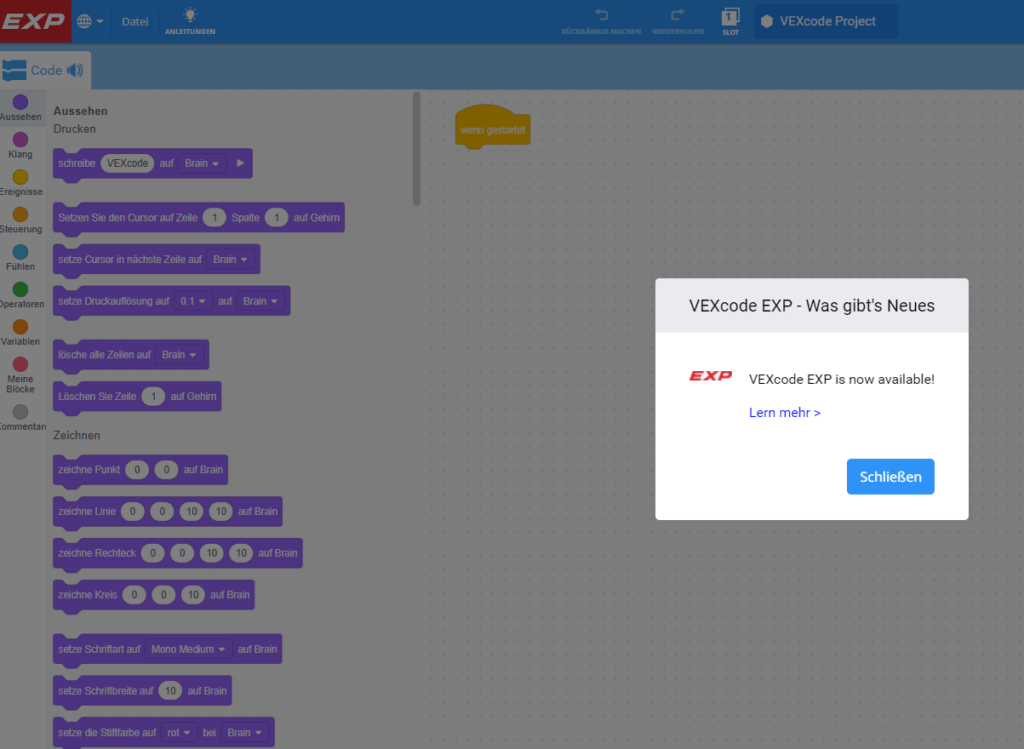
VEXcode EXP is now available in a web-based version for Chrome browsers. The web-based version can be reached by navigating to codeexp.vex.com and contains all of the features and functionality of VEXcode EXP, but without the need to download or install anything! The new web-based version of VEXcode makes it easier for teachers and students to access projects from anywhere, at any time, on any device – including Chromebooks!
In addition to the built-in Help and Tutorials, the STEM Library contains additional resources and support for using web-based VEXcode EXP. Within the STEM Library you can find device-specific articles for connecting to web-based VEXcode EXP, loading and saving projects, updating firmware, and more. View the VEXcode EXP section of the STEM Library to learn more.
Web-based versions of VEXcode IQ and VEXcode V5 are in the works and will be available soon.
We, the Munich Institute of Robotics and Machine Intelligence (MIRMI) of the Technical University of Munich (TUM), in collaboration with Messe München
and automatica have launched successfully a new high-tech platform calledmunich_iin 2021, an event bringing together the world’s leading thought leaders and personalities from AI and robotics.
munich_i will take place again at the next automatica from June 21-24, 2022 in Munich, therefore
Robothon®, the international competition to develop skills in robot manipulations, will also go into the second round!!
Robothon® – The Grand Challenge Series focuses on pressing and unsolved challenges of our time and was 2021 held digitally in the run-up to the automatica sprint
with 9 international teams and a renowned Grand Challenge Jury. As a highlight, it ended with the Award Ceremony on June 22, 2021
with 4 winning teams, a total prize money of € 22,500, great recognition and an expansion of our community.
Are you a motivated robotics enthusiast looking for new challenges?
Judges recognize the world’s first haptic robotic system to transmit realistic touch feedback to an operator located anywhere in the world
Converge Robotics Group reached the finals of the $10M ANA Avatar XPRIZE competition for an avatar system that can transport human dexterity to a remote location in real-time.
Converge Robotics Group is an international collaboration between Shadow Robot Company, HaptX, and Tangible Research responsible for developing the Tactile Telerobot, a high-fidelity dexterous telerobot in use in the U.S., U.K., and Asia, and now advanced to the ANA Avatar XPRIZE finals.
The Tactile Telerobot features Shadow Robot’s Dexterous Hands, HaptX Gloves DK2 with true-contact haptics, SynTouch’s biomimetic tactile sensors, and Universal Robots robotic arms to allow an operator to perform complex human tasks instantaneously across the globe such as handling objects in laboratories or workshops. The Tactile Telerobot mimics your movements, displaying human-like and reactive behaviours. Users can feel what the robot hands are touching, making it possible to connect humanity across vast distances like never before.
The groundbreaking technology of the Tactile Telerobot has been described as “weirdly natural” by Amazon founder Jeff Bezos, who added, “The tactile feedback is really tremendous.” The Telerobot’s most recent improvements for the XPRIZE Semifinals, hosted in Miami, include the use of high-fidelity audio and visual technology and other safety and usability improvements. It meets the competition’s criteria for a non-autonomous Avatar System with which an operator can see, hear, and interact within a remote environment in a manner that feels as if they are truly there.
Rich Walker, Managing Director of the Shadow Robot Company, said, “We’re coming up to Shadow’s 25th anniversary as a company and what a way to lead up to it by reaching the finals for a four-year global competition! The Shadow Dexterous Hands have been a sought-after product among the research community ever since we formally registered as a company. What the Hands can achieve today, on their own and as part of the Tactile Telerobot, is truly revolutionary and it’ll only get better.”
“Lifelike touch feedback is a critical component of transporting human presence,” said Jake Rubin, founder and CEO of HaptX. “The Tactile Telerobot demonstrates the difference that true-contact haptics makes in the field of robotic teleoperation, and we’re delighted for HaptX and our partners in Converge Robotics Group to receive this recognition from the ANA Avatar XPRIZE judges.”
“I’m proud of the accomplishments of our international and interdisciplinary team,” said Jeremy Fishel, founder and CTO of Tangible Research and Converge’s XPRIZE team lead. “We’ve brought together experts in robotic dexterity and haptics with the amazing technology of our partners and collaborators to do amazing things.”
In the XPRIZE Semifinals, the Converge Robotics Group debuted their collaboration with Voysys, a company that specialises in high-quality, low-latency video communication for the teleoperation of vehicles and machines.
„The combination of the Voysys video pipeline with ultra-low latency, the HaptX Gloves DK2, and the sensitive robot hand from Shadow Robot truly revolutionizes telepresence and makes remote working possible for a whole range of new industries,“ said Magnus Persson, CEO of Voysys.
“Advancing to the ANA Avatar XPRIZE finals alongside excellent competition is a significant milestone in this journey,” said the Converge Robotics Group in a statement “We look forward to showing how our Telerobot system can be used by ordinary people in amazing ways, making engineering jobs safer, reducing the need for global travel (and CO2 emissions) and letting us spend more time at home with our loved ones.”
Mit dem ROBOTICS TXT 4.0 Base Set von fischertechnik lassen sich komplexe Technologien aus dem Alltag im Unterricht spielerisch erlernen. Vier Ergänzungssets ermöglichen darüber hinaus das Eintauchen in die Welt des autonomen Fahrens, in Roboterprogrammierung und in Internet of Things. Mit dem Set „Competition“ lassen sich zudem spannende Aufgaben bei Robotics-Wettbewerben oder -Projekten umsetzen.
Das fischertechnik ROBOTICS TXT 4.0 Base Set ist der perfekte Start, um zu programmieren wie die Profis. Der umfangreiche Baukasten enthält neben der Kamera mit Bildverarbeitung einen Ultraschallsensor, zwei Encodermotoren, einen Spursensor, einen Fototransistor sowie zwei Taster und drei LEDs. Die Modelle können mit der Programmiersoftware ROBO Pro Coding und dem ROBOTICS TXT 4.0 Controller programmiert und gesteuert werden. Einsteiger können auf fertige Beispielprogramme zurückgreifen und in der Blockly-Programmierumgebung ROBO Pro Coding grafisch programmieren, Fortgeschrittene und Profis können darüber hinaus direkt in Python loslegen. Mit der zusätzlichen App fischertechnik Voice Control (Android/ iOS) kann der TXT 4.0 Controller auch über Spracherkennung gesteuert werden. Enthalten sind zwölf spannende Modelle, die von der Fußgängerampel über eine Schranke, einen Barcodescanner bis hin zu mobilen Fahrrobotern mit Encodermotoren, Kamera, Spur- und Abstandssensor reichen. Das umfangreiche Lehrmaterial beinhaltet neben Einführungs- und Basisinformationen 25 Experimente mit Lösungen.
Das fischertechnik ROBOTICS TXT 4.0 Base Set stellt die Basis für den Einsatz im Regelunterricht dar: Controller, Software, Stromversorgung, Aktoren und Sensoren und viele Grundbausteine sind hier enthalten. Das Set wird in einer stabilen Box geliefert, die sich für Einsatz im Regelunterricht sowie auch für Projektarbeiten bestens eignet. Die separat erhältlichen vier Add On Sets erweitern das TXT 4.0 Base Set um ihren jeweiligen Schwerpunkt und können übersichtlich in der unteren, dafür vorgesehenen Wanne integriert werden.
Die Add On-Erweiterungssets umfassen spezifische Hightech-Themen wie autonomes Fahren, Omniwheels und IoT (Internet of Things) sowie Robotics-Wettbewerbe. Damit können attraktive Modelle wie ein autonom fahrendes Auto, ein Fußballroboter oder eine Sensorstation mit beweglicher Kamera zur Messung von Temperatur, Luftfeuchtigkeit, Luftdruck, Luftqualität und Helligkeit konstruiert werden.
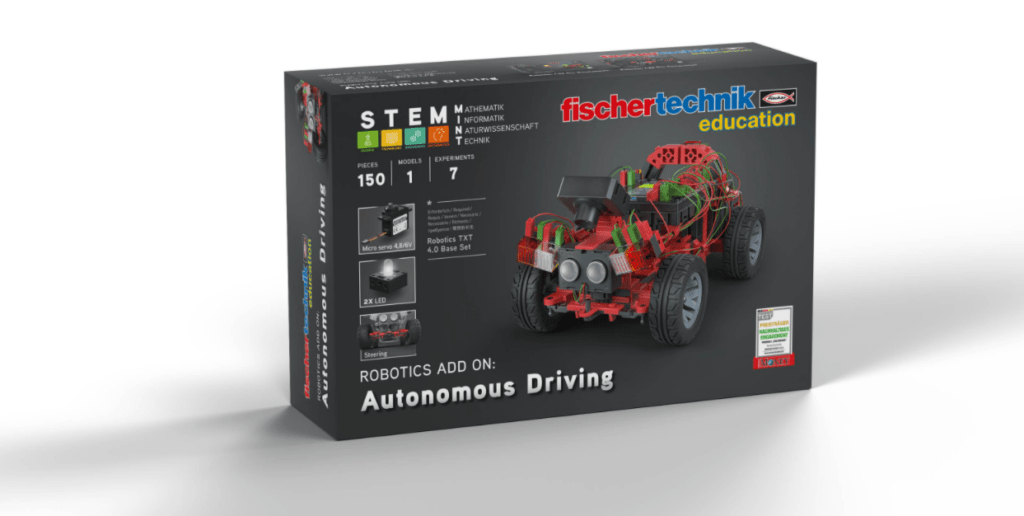
Mit dem ROBOTICS Add On Autonomous Driving lässt sich das Auto der Zukunft selbst bauen und programmieren. Es bietet die Möglichkeit, zusammen mit dem ROBOTICS TXT 4.0 Base Set viele spannende Techniken zu entdecken: Von der Lichtautomatik über einen Spurhalteassistenten, vom Tempomat bis zur Einparkautomatik – das Modell garantiert begeisterte Augen im Unterricht. Der Baukasten enthält neben einem Differenzialgetriebe zwei zusätzliche Räder, LEDs sowie einen Servo-Motor für die Lenkung. Das Add On Autonomous Driving wird durch das Lehrmaterial, das Aufgaben und Experimente mit zugehörigen Lösungen enthält, abgerundet.
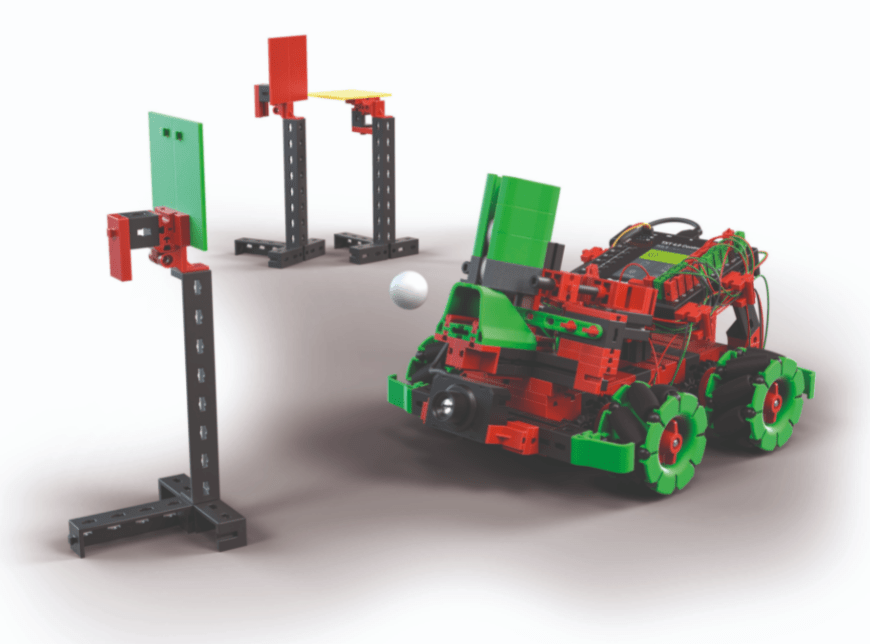
Das Add On Omniwheels ermöglicht zusammen mit dem ROBOTICS TXT 4.0 Base Set das Konstruieren verschiedener Modelle mit Allseitenantrieb: Fahrroboter mit verschiedenen Aufgabenstellungen, zum Beispiel ein Fußballroboter, ein Ballwurfroboter, der Zielscheiben erkennt und präzise trifft und ein Malroboter mit Stift, der abgesenkt und angehoben werden kann. Das Highlight des Baukastens sind die Omniwheels, die von vier Encodermotoren angetrieben werden und so eine Bewegung in verschiedene Richtungen ermöglichen. Die im TXT 4.0 Base Set enthaltene Kamera ermöglicht Bildverarbeitung, durch die beispielsweise der Fußballroboter einen Ball erkennen, ihm folgen und Tore schießen kann.
Einen professionellen Einstieg in die Messwerterfassung bietet das Ergänzungsset ROBOTICS Add On IoT. Zusammen mit den Robotics TXT 4.0 Base Set ermöglicht die Sensorstation die Messung von Temperatur, Luftfeuchtigkeit, Luftdruck, Luftqualität und Helligkeit. Die Sensorstation kann mit der Programmiersoftware ROBO Pro Coding und dem ROBOTICS TXT 4.0 Controller programmiert und gesteuert werden und ist ideal, um Themen wie Messwerterfassung und -übertragung sowie das Steuern und Regeln von Aktoren und Sensoren zu vermitteln. Die Messwerterfassung erfolgt über die Verbindung des TXT 4.0 Controllers mit der fischertechnik-Cloud, in der die Sensordaten gespeichert, gesammelt und grafisch dargestellt werden. Über die Bedienoberfläche, dem sogenannten Dashboard, werden die verschiedenen Sensordaten permanent (in Echtzeit) erfasst und die in zwei Achsen schwenkbare Kamera ferngesteuert. Das Lehrmaterial des Add On IoT enthält sechs Experimente mit dazugehörigen Lösungen.
Das ROBOTICS Add On Competition wurde für Schulen, Universitäten und alle Bildungseinrichtungen entwickelt, die ihre Modelle für Robotics-Wettbewerbe für ihre Schüler und Studenten weiterentwickeln oder verbessern möchten. Mit diesem Set lassen sich Modelle tunen und um neue Features erweitern, was diesen Baukasten zur perfekten Ergänzung für Wettbewerbe auf der ganzen Welt macht. Das Set enthält den neuen RGB-Gestensensor, einen Kombisensor (Gyroskop, Beschleunigung und Kompass), einen Ultraschallsensor, zwei stärkere Encodermotoren sowie Kettenglieder und Rastraupenbeläge für das Fahrgestell eines Raupenroboters – ideal für den Bau wettbewerbsfähiger Fahrroboter.
Robotics researchers from the Oxford Universities Robotics Institute, have contributed to the winning team, Team CERBERUS, at the DARPA Subterranean Challenge – coming away with the top prize of $2m. The finals of the competition concluded on Friday in an underground cavern in Louisville, Kentucky with 8 international teams going head-to-head.
Underground settings present significant challenges for civilian first responders, with unknow hazards and conditions that can vary drastically or change quickly. The DARPA Subterranean or „SubT“ Challenge was established to stimulate new approaches to rapidly map, navigate, and search underground environments during time-sensitive disaster response scenarios.
The challenge took place over three years and was designed to push the boundaries of autonomous robotic technology. The task was to explore an underground environment and to locate objects such as mannequins – simulating injured humans, – backpacks, phones and tools.
‘We are delighted to have done so well. Contributing to CERBERUS has really accelerated our research. After 3 years of preparation, it was fantastic to test it in the DARPA’s complex underground maze’. Said Prof. Maurice Fallon, lead of the Oxford University team.
Points were awarded when an object was correctly located. Challenges included locomotion over rough terrain, accurate mapping, and coordination of the robot team by a single operator from outside the test location. The test location blended aspects of cave, tunnel and urban subways and was often unlit, filled with smoke or on a steep slope.
CERBERUS*, deployed a team of four quadruped robots, called ANYmals, as well as autonomous aerial vehicles in the competition organized by the US Government research agency DARPA.
‘In the underground environment there are so many challenges from lighting and communications to the slipperiness of terrain itself. This demanded a whole range of breakthroughs by our team’. Said Dr. Marco Camurri, Senior researcher, Oxford University.
In the end CERBERUS tied with a team from CSIRO – a research lab based in Brisbane, Australia – winning only on a tiebreaker. Other teams included representatives from top universities such as University of Colorado, Boulder (in 3rd place), Carnegie Mellon University, Massachusetts Institute of Technology (MIT) and Jet Propulsion Laboratory (part of NASA).
It is envisaged that the technologies will impact on disaster response, environmental monitoring, industrial inspection, and construction sectors.
Der Preis für Automatisierungslösungen mit einem schnellen Return-On-Invest geht in die 2. Runde
Köln, 9. September 2021 – Sie automatisieren die Verpackung, sortieren Waren und helfen bei gefährlichen Aufgaben im Arbeitsalltag: kostengünstige Robotik- und Automatisierungslösungen von igus. Die kreativsten Anwendungen zeichnet der motion plastics Spezialist auch 2022 wieder mit dem ROIBOT Award aus. Gesucht werden Projekte, die mithilfe von igus Low Cost Automation und drylin Antriebsachsen einen schnellen Return-on-Invest erzielen konnten. Die Gewinner erhalten ein frei wählbares Robotik-Paket von dem Marktplatz RBTX.com im Wert von bis zu 5.000 Euro.
Über 70 Bewerbungen aus aller Welt gingen im letzten Jahr für den ROIBOT Award 2019/2020 ein. Der Preis kürt Automatisierungsprojekte, die kostengünstige Robotik- und Automatisierungslösungen von igus einsetzen. Die Sieger aus Salzburg (Österreich) durften sich dabei über ein Preisgeld von 5.000 Euro freuen. Die Studenten konstruierten ein mobiles Robotersystem mit Greifer, um gefährliche Handling-Aufgaben zum Beispiel im Handwerksbereich aus der Entfernung umzusetzen. Dazu kommt ein mit Sensorik ausgestatteter Handschuh zum Einsatz, der eine intuitive Steuerung durch Gesten ermöglicht und das mit Feedback. Für den kostengünstigen und wartungsfreien robolink D-Gelenkarm von igus entwickelten die Ingenieure ein Antriebssystem, ein Akkusystem sowie ein mechanisches Gerüst. Das Projekt überzeugte die Fachjury und gewann den ersten Platz. Den zweiten Platz belegte das Pick & Place-System für den Healthcare Sektor von Apostore. Es besteht aus einer Roboterzelle und einem Versorgungssystem für die zuführende Schüttgut-Ware. Den dritten Platz erreichte die deutsche Firma Superwurm. Die Regenwurmzüchter entwickelten mithilfe von igus Low Cost Automation eine Anlage, die Würmer automatisiert abzählt und in Dosen verpackt.
ROIBOT Award geht 2022 in die nächste Runde
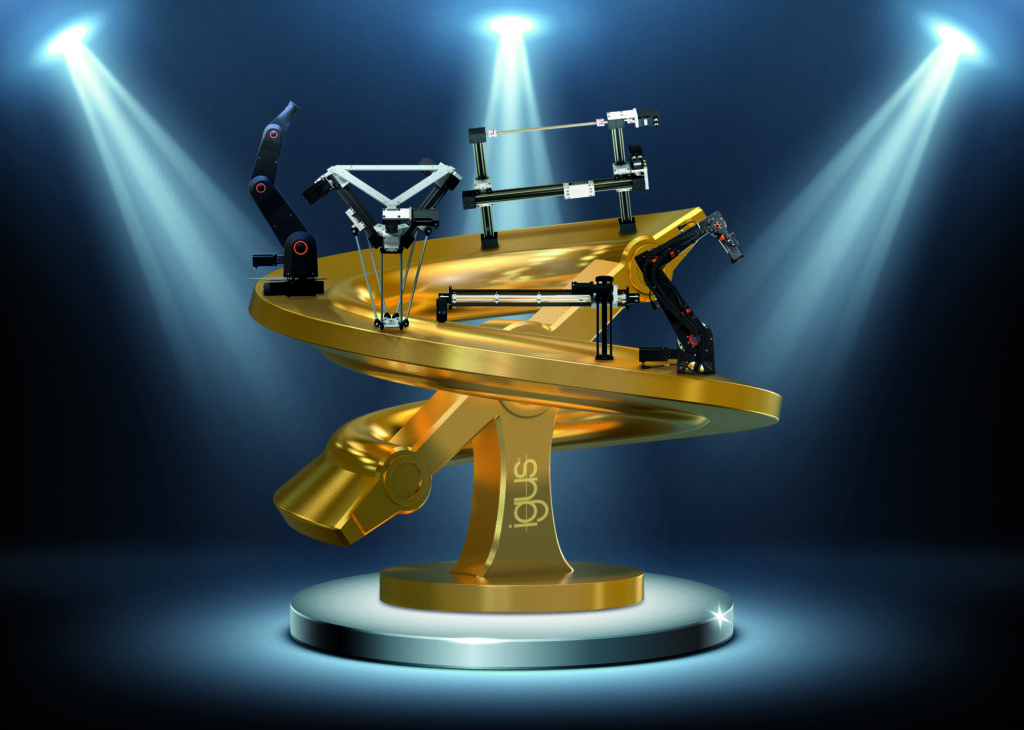
Der ROIBOT Wettbewerb sucht auch jetzt wieder weltweit nach bereits bestehenden Low Cost Automation Anwendungen, die zu einem schnellen Return-on-Investment geführt haben. Zum Einsatz können sowohl robolink Gelenkarmroboter, drylin Delta-Roboter, kartesische Roboter sowie drylin Antriebstechnik von igus kommen. Eine Fachjury bewertet die Konzepte. Eine spannende Einreichung, die sich durch Kreativität und einem Optimierungsgedanken auszeichnen, führt zu einer hohen Bewertung. Der Gewinner erhält ein frei konfigurierbares Robotik-Paket im Wert von 5.000 Euro, der zweite Platz kann sich für 2.500 Euro und der dritte Platz für 1.000 Euro Automatisierungslösungen auf RBTX.com aussuchen. Einsendeschluss ist der 30. April 2022. Die Preisverleihung erfolgt durch igus auf der automatica 2022 in München, der Leitmesse für intelligente Automation und Robotik. Auf der Website igus.de/roibot-anmeldung können sich die Teilnehmer bewerben.
The Robotics Education & Competition (REC) Foundation, a 501c3 nonprofit and VEX Robotics, is back to showcase the incredible talent and skill of a range of student competitors by hosting the first-ever Live Remote VEX Robotics World Championship May 17-29, 2021. Leveraging the REC Foundation’s Live Remote Tournament interface, teams from around the world will be able to compete in real-time tournaments or live skills matches to be crowned champions.
During the live remote event, students in grades three through college will compete in timed, heart-pounding robotics competition matches with their custom-built robots. Like at past world championships, competitors will have the opportunity to see familiar faces, activities, and share the excitement of the event.
To ensure the safety of its robotics community due to the pandemic, this unique event will adapt to a virtual format. Typically, the annual VEX Robotics World Championship attracts more than 30,000 attendees from all 50 states and more than 70 nations.
MindCuber-RI is a robot that can solve the well-known Rubik’s Cube® puzzle. It is designed by David Gilday and Mike Dobson.
It is built using elements from a single LEGO® MINDSTORMS® Robot Inventor set 51515.
MindCuber-RI is significantly faster than previous MindCuber and PrimeCuber designs because it makes use of the fourth motor available in the Robot Inventor set to implement a faster tilting mechanism. Older MINDSTORMS and SPIKE Prime sets only included three motors.
Building instructions and software are now available on http://mindcuber.com/mindcuberri/mindcuberri.html alongside those for MindCuber for LEGO MINDSTORMS NXT, MindCub3r for LEGO MINDSTORMS EV3 and PrimeCuber for LEGO Education SPIKE® Prime.
At this year’s automatica sprint from 22-24 June 2021, munich_i celebrates its premiere as a hybrid version and brings together leading global thought leaders and personalities from AI and robotics.
Due to uncertain planning during the pandemic and travel restrictions, we have now decided to realize the Grand Challenge 2021 in a 100% digital version!
With this, we want to offer all international academics and young professionals the opportunity to participate in the Robothon®!
NEW DATE & BENEFITS: the Robothon® will take place digitallyin the period from 14 May–17 June, 2021!
As a special highlight, the Award Ceremony will take place on 22 June at noon during the Hightech Summitat automatica sprint 2021!
We put our heads together and came up with a new, exciting concept for the digital realization.
WHAT’s NEW?
– You and your team can work remotely
– Teams will need to supply their own robot for the competition
– Each team will receive a competition task board by mail to complete the challenge
– Teams will be given 1 month from receipt of the competition scorecard and task board to develop their solution
– Team performances will be evaluated based on a recorded video submission and a live presentation with the judges
via our digital platform at the end of the working period
– The winning teams will be honored digitally by the jury and sponsors at our Award Ceremony, that will take place at
noon during the Hightech Summit at automatica sprint
WHAT’s the SAME?
– The Robothon® – The Grand Challenge 2021 will focus on the single-arm robot manipulation showcasing
skills for the disassembly and sorting of electronic waste
– The digital concept will continue to be part of munich_i during automatica sprint
– The competition is open to the public and free of charge for selected teams
– Up to 20 teams can participate (2-5 members per team)
– All roboticists (academic and young professional) are encouraged to apply
– Final demonstrations will be evaluated by our Grand Challenge Jury of renowned international thought leaders
– Prizes up to 20,000 € have already collected!
HAVEN’T SIGNED UP YET? Find more information and apply as a team until 23:59 CEST 25 April 2021