
3D printing will be super easy with Doodle3D Transform, now on Kickstarter

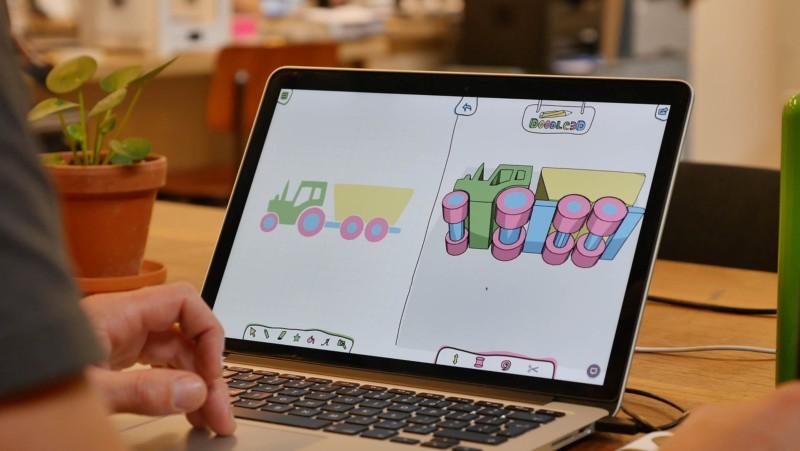
Doodle3D, based in The Netherlands, is working on their second crowdfunding campaign on Kickstarter. They are launching their new 2D-to-3D design app called Doodle3D Transform, which makes 3D-design and 3D-printing childsplay. The campaign runs until the 21st of October and has currently achieved 50% of its target.

In the application, simplicity is key. What makes it stand apart from the many other 3D design applications, is the fact that the user designs 3-dimensional shapes based on flat (2D) drawings.

Because of its accessibility, anyone can use the app to create their ideas, no matter their age or background.

Doodle3D Transform runs on Android, Apple and Windows tablets and computers. Designs can be 3D printed with your own 3D printer, or by using one of the many 3D printing services. The Doodle3D WiFi-Box, which was successfully funded on Kickstarter in 2013, can be used to wirelessly print your designs. For more information visit www.doodle3d.com.

WiFi Motors That Will Take the Mess and Stress Out of Your Projects Startup launches Kickstarter campaign

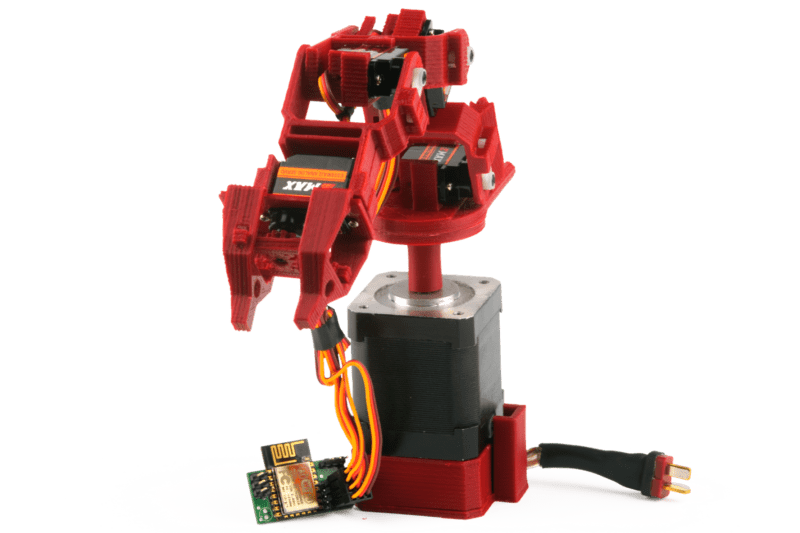
SYRACUSE, NY, SEPTEMBER 27, 2016- Basement startup OpenMYR is announcing a Kickstarter campaign starting October 3rd for a revolutionary new way to use motors by controlling them entirely over WiFi. Their innovative open-source wifi-controlled motors are designed to simplify the motorization of any hobbyist, maker, robotics and home automation project. Thanks to the work of three young friends, all you need to use a motor is power and your phone (or any other WiFi device).

Previously, utilizing a motor in a project required extensive wiring and coding, often involving additional components such as an Arduino. This is a daunting task that usually ends with an ugly mess and hours of coding. OpenMYR’s goal was to make motorizing a project so simple that even a child could do it, while providing powerful tools for advanced users to easily create complex projects.

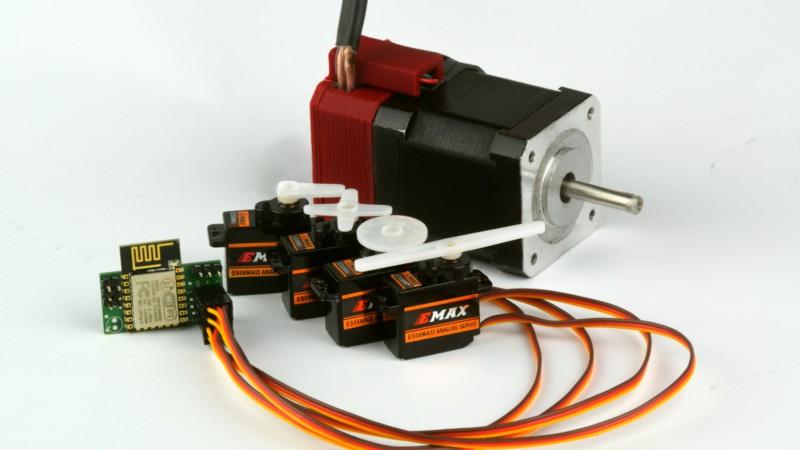
OpenMYR’s two products can be easily built into projects, eliminating the mess. Their $60 all-in-one WiFi Stepper Motor contains all the electronics in an elegant inline case, and can be attached to any project that supports a NEMA-17 motor. Their $35 WiFi Servo Controller is a small and sleek board to which the user can attach up to four hobby servos at once.

Programming is no longer a requirement of using motors, as OpenMYR’s motors can be effortlessly controlled with the official smartphone app or the motor’s self-hosted webpage. More advanced controls are available through computer utilities and programs. Coders will be delighted to know that they can control any number of motors directly with virtually any programing language.

Both the WiFi Stepper Motor and WiFi Servo Controller are powered by the powerful ESP8266 system, which has been gaining popularity over the last two years among hardware enthusiasts. OpenMYR’s hardware designs and software code are open source, so the community can benefit from the team’s work without having to buy in.

“At first, we only thought these motors would be useful where wiring was difficult,” said founder Kyle Berezin. “However, it soon became obvious that we had found a better way to use motors in any project.” Berezin had hit upon the idea while prototyping a design for a large 3D printer, and discovered that wifi-enabled motors didn’t exist as a consumer product. “Our motors empower people of all skill levels to bring their ideas to

life. No longer do you need to be an electrical engineer and a programmer to use motors.”

The campaign will fund the creation of the stepper motor and a servo motor controller, as well as the smartphone apps and computer applications for controlling the motors. As expected with Kickstarter, backers will be rewarded with assortments of motors depending on how much they donate, including reward tiers that act as combo packs to get both the stepper motor and servo controller in various quantities.

About OpenMYR

OpenMYR is a three-person tech startup based in Syracuse, NY. Operating out of a basement, founder Kyle Berezin and software architect Brandon Brown work on code and logistics, while satellite member Chris Adams works on the hardware designs. Driven by a love of cool open-source projects and tasty food, OpenMYR has spent 2016 revolutionizing motor control. OpenMYR’s website is http://openmyr.com and its Twitter is @OfficialOpenMYR.

Robomotive Labratories introduces immersive reality robot

Cincinnati-based Entrepreneur launches Kickstarter campaign to bring ‘mimic’ innovation to more people

Cincinnati, OH (Oct.1, 2016) – Robomotive Laboratories is changing the way the world sees robotics with the introduction of their transformative new robot, mimic. Today, the Cincinnati-based small family business launched a new Kickstarter campaign (https://www.kickstarter.com/projects/713401305/mimic-immersion-robot) to help advance the development and production of the new technology.

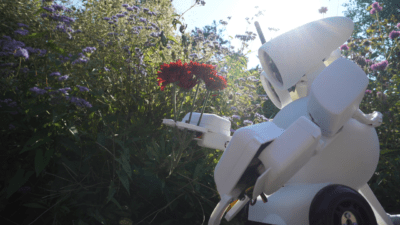
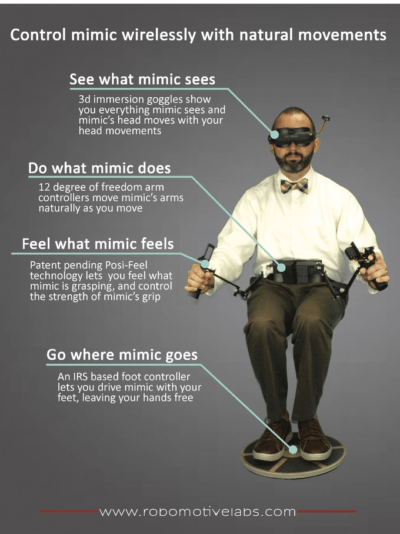
Mimic represents a technological breakthrough in the way people interact with a robot. Through a series of interfaces and controls, the user is transported and able to see what mimic sees, do what mimic does, feel what mimic feels, and go where mimic goes.

“After a successfully-funded Doorbell Phone campaign on Kickstarter, I began to indulge in my love of robotics and introduced the Cortex:Robot Arm controller,” said Brett Pipitone, founder of Robomotive Laboratories. “We continued to develop the technology by adding joints, cameras and motion and soon realized that we had developed something truly unique: The mimic robot was born.”

The key to bringing mimic to life is the mimic arm controller with patent-pending Posi-Feel grip controllers. The user wears a device that allows the seamless control of mimic’s arms and grippers by moving his or her own hands and arms in natural ways while holding two simple handles with trigger style grip controllers. A series of joints, pivots and sensors are built onto the mimic Arm Controller to make this possible.

Mimic can also move around on its own power, controlled by the user with an IRS based foot controller. The user places both feet on the controller and tilts the device forward, back, left, or right to command mimic’s movements in natural, hands free ways.

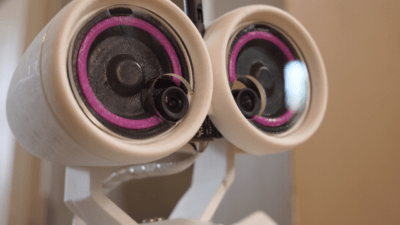
To complete the user’s sense of immersion, immersion goggles receive 3D video from a pair of cameras in mimic’s eyes. Not only does the user see what mimic sees in vibrant 3D, but using a series of sensors and motors the user’s head motion is duplicated by mimic’s head, allowing the user to change view by simply moving his or her head.

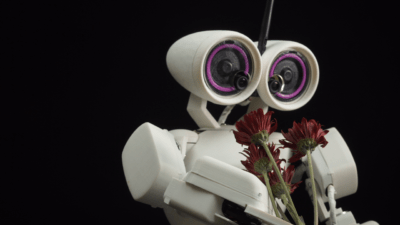
This assemblage of new technologies allows the user to see the world from a fresh, new point of view- that of a 12 inch tall, wide-eyed, rotund little robot. In the words of Robomotive Laboratories founder Brett Pipitone „mimic represents a technological breakthrough in think about human interfaces by adapting the robot to the user, rather than the other way around.“

Robomotive Laboratories realized early that a single version of the mimic robot would not fit all users needs, so backers have a choice of four versions of the robot, each design with a different use in mind.

  • The mimic:maker version comes in kit form for the user to assemble. The kit includes a robot with two arms and grippers, as well as a mimic arm controller. The kit does not include a body, however, so the user can tailor the robot to their needs or to make something new. For even more flexibility, all the electronic inputs and outputs are exposed to be manipulated or utilized by the user, including record and playback through an on board SD card. „The future is being invented in basements, garages, and maker spaces all over the world. That’s where mimic was born, and mimic:maker is a chance for other tinkerers to use and improve it,“ says Pipitone.
  • The mimic:play comes as a fully assembled robot, including the 12- degrees-of-freedom arm controller. While mimic:play doesn’t have as many features as some offerings, it’s just as adorable and its simplicity makes it more accessible for some users. Fun features like the mimic arm controller, Posi-Feeel grippers, and on-board SD card are included. As Pipitone suggests, “mimic:play is simpler than the other versions, but still offers intuitive control and a sense of feel. It’s great for younger users or for interactive settings.”
  • The mimic:social has all the features of mimic:play, but also adds the IRS based foot controller, 2D camera, and a video receiver to be attached to the user’s television. „People love the concept of interacting from a distance,“ says Pipitone. „It’s great fun to put mimic:social in a room and watch it’s interactions on TV with your friends.“
  • The mimic 3D is the most advanced and full featured version offered and includes the mimic arm controller with Posi-Feel grippers, the foot controller, and SD card, in addition to the immersion googles and 3D cameras. With this full suite of features the user can completely loose themselves in mimic’s world. „This robot really transports you to an immersive reality. Everyday things seem huge, and you can interact from an entirely new point of view,“ describes Pipitone. „I can interact with my baby daughter on her level as an equal, while it’s simple enough that my 6 year old son can pick it up and use it. It’s an indescribable experience.“

The implications of the mimic immersive reality robot are great, and users can be a part of it now by backing mimic on Kickstarter. According to Pipitone, „We’ve delivered the personal robot of the future. We’re still working on flying cars and jet packs.“

For more information, please visit: http://www.robomotivelabs.com/.

blinkgogo – Wireless program Arduino & Fun Robotic Learning Platform

I just received this information from the blinkgogo team:

Wireless program Arduino & Fun Robotic Learning Platform. Designed for STEM education, Open Source! APP controlled, based on  Arduino, supports Scratch. Let kids Play and Learn!

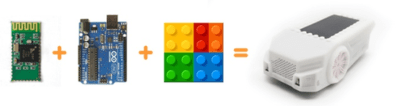
Blinkgogo is a open source fun STEM robotic learning platform based on Arduino. Blinkgogo supports wireless Bluetooth upload, APP controlled, Scratch.

This robot kit has everything you need to get started. You can demonstrate many standard robot functions right out of the box. It’s simple, easy to use and fun.

With Blinkgogo, you can build many standard robots for example Line Following robot, Light Seeking robot, Edge Detection robot, APP control robot.

It comes with 3D printed shell and compatible with LEGO blocks.

Blinkgogo also comes with a hardware expansion board for those who really want to go wild when it comes to trying new things and developing new robotics systems.

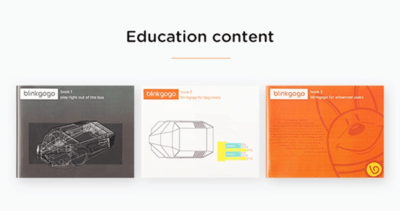
Blinkgogo comes with three step-by-step tutorials to help you learn programming.

  • Binkgogo play right out of the box Tutorial: Blinkgogo works right out of the box. You can demonstrate many standard robot functions. You can drive it by controlling it with your phone through it’s Bluetooth capability. Or have it follow a black line.
  • Blinkgogo for Beginners Tutorial:Blinkgogo comes with a number of step-by-step tutorials. It is easy to program with the scratch graphical programming language. For the more extreme programmers it also works with C++. And the Arduino IDE programming environment
  • Blinkgogo for Advanced Users Tutorial:Blinkgogo offers a lot for advanced users. Blinkgogo comes with a hardware expansion prototyping plate where you can mount servos and many other sensors.

Its perfect for STEM education:

In the home

Perhaps your home has many toys already. However we believe to prepare for the future children need toys that are made to be modified and programmed. Children need to learn not just to be consumers but to actively participate in the building and modifying of things around them.

In school

Everybody knows that STEM education is important however most robotics platforms do not come with enough easy to use tutorials out of the box to be used by most non-engineers and still have enough flexibility to be still useful to those who excel in programming.

Why we made this kit?

Ever since I was a child I have always wanted to learn how to make electronics. Now that I am an electrical engineer my dreams are now a reality. However in the past when friends and asked if they could do electronics, my only answer was you need to go to school to be an electrical engineer.

Luckily time to change. Thanks to Arduino and other open-source platforms it’s not only possible for my friends to start their own hobby electronics products I can now start teaching my two children Harry and Tina. I have selfishly developed Blinkgogo specifically to teach my children electronics. But due to enthusiasm from my neighbors I have developed Blinkgogo into a product to share with the world. I hope you have as much fun with Blinkgogo as I did developing it and share it with my children.

We are on kickstarter now!

We are now crowdfunding on kickstarter now. We got over 60% funds within 24 hours. Please support us and let more kids can enjoy this all-in-one robotic learning platform!

Website:  www.blinkgogo.com

Video:              https://www.youtube.com/channel/UCgj2axca16VY3bHaIBzzzuQ

Facebook: https://www.facebook.com/blinkgogorobot/

Twitter:  https://twitter.com/BlinkgogoRobot

Google+:  https://plus.google.com/u/0/111819239969740793655

Kickstarter link: https://www.kickstarter.com/projects/makerstudio/blinkgogo-wireless-arduino-and-fun-robotics-learni?ref=4a4oio

Trending on Kickstarter: ‘MOTI’ is your personal robotic companion for building healthy habits

SAN FRANCISCO, CALIF. —  Emerging from an industry saturated with apps and wearables, San Francisco based startup MOTI (www.moti.io) is seeing tremendous support on Kickstarter, exceeding a goal of $50,000 within the first five days of launching. At 23 days left on the campaign, MOTI has over 700 backers, and has now released additional “stretch goals” for their little robot. These goals include adding a wild card color that backers can vote on, integrations with Fitbit, Evernote, and Google Calendar, as well as a new top secret feature – should the campaign reach $175,000.


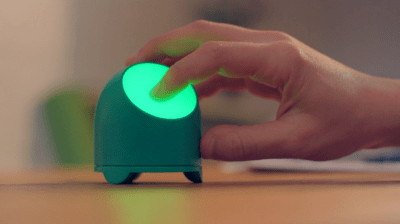
Who is this little robot and why is everyone so intrigued by him? First, MOTI is a physically present smart companion for building better habits. The device combines insights from behavioral science, social robotics and human-centered design, and is built to learn and react to human beings’ psychological triggers with the purpose of getting them to start practicing healthy habits (such as jogging, hydrating, meditating, etc). Second, what makes him different is that unlike a standalone app, MOTI’s very physicality, presence, and emotional AI contributes to his ability to effectively influence behavior. Standing at just under three inches tall, MOTI acts as an ever-present environmental queue that is meant to interact with you in the moments and places where you would normally start forming your habit (i.e. your kitchen, your work desk, your yoga space,etc.).


The science and design behind MOTI’s habit-forming influence draws from the habit-loop theory, which explains that in order to build any habit, three things are required: a trigger, a routine, and a reward. To help you form your habit, MOTI supports all three things through a combination of lights, haptics, human-like intonations and other sounds. In order to have the best effect on behavior, MOTI is also designed to form a bond with the user, and his personality is continually adapting to the users’ needs.


“What we found in early research is that apps and wearables rely on data, graphs, and tracking for motivation,”  says Kayla Matheus, Inventor and Co-Founder of MOTI. “But we’re human – we need more than just numbers. We need our technology to understand how we work at a psychological and emotional level. That’s why MOTI isn’t another device – he’s your friend, or your cheerleader, or even your mom.”


Live demos are available today at BulletProof Bio-Hacking conference, and customers can now pledge an order for their own MOTI at http://kck.st/2d8NBu2 , on sale for $99 each and available in light grey, dark grey, and turquoise.  


About MOTI

MOTI is a behavior change company combining science and design to create transformative products that help people live better lives, one habit at a time. Established March 2015 in New York City, the company is led by Founder and CEO Kayla Matheus (Yale BA’11) and Founder/COO Laura Day (Vanderbilt BE’02, Harvard Business School MBA ‘09). MOTI is an alum of Google 30 Weeks and Highway1 Accelerators. Connect with MOTI via Facebook, Twitter, and Instagram (@habitMOTI) or visit www.moti.io to learn more.

Giant Cardboard Robots

I just received this message from the „Giant Cardboard Robots“-Team:

Are you in need of inspiration for your kid’s next Halloween Costume? Check out Giant Cardboard Robots, a project that makes Kid-Sized Giant Cardboard Robot Arms a reality.

At Giant Cardboard Robots, we have been making and selling adult size giant cardboard robot arms for the past several years, and now we have put together an offering especially for the junior giant robots among us.

Our Kickstarter rewards include DIY kits for cardboard robot arms in both the kid and adult sizes, plans to allow crafters to make their own robot arms from cardboard they have laying around, as well as some truly unique corrugated creations ranging from a giant robot pirate hook to a wearable giant cardboard jack-o-lantern head.

We have launched a Kickstarter campaign that will run until September 30 and has been picked by Kickstarter itself as a „Project We Love“.


More information: http://kck.st/2bqTqjP

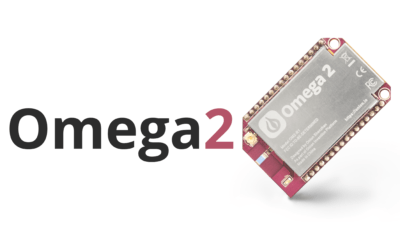
Onion Launches the Omega2 to Bring Innovation to the Internet of Things (IoT)

July 29, 2016 – Onion announces the Omega2, the IoT development board aimed at bringing innovation back into the IoT space. The Omega2 launched on Kickstarter last week and is currently more than 1,100% funded, with 25 days left to go in the campaign. Campaign Link: https://www.kickstarter.com/projects/onion/omega2-5-iot-computer-with-wi-fi-powered-by-linux
IoT never really gained mainstream status. Most „smart“ products on the market are nothing more than ordinary products with a screen slapped on it. These products don’t bring true value, so as soon as the novelty factor wears off, consumers move on to try the next „smart“ thing. Innovation in IoT is driven not by the needs of the market, but by the need of product companies to create new products and turn a profit. To bring innovation to IoT, the products need to be repositioned to address real pain points in everyday life. Onion aims to do that with the Omega2 by making hardware development accessible so everyone can start solving problems in their lives with IoT technology.

„We created the Omega2 to be the most accessible hardware development board,“ says co-founder and CEO Boken Lin. „We do this in two ways, by making it extremely affordable, and by making it very beginner-friendly. There is always a risk involved with trying new things, and by reducing the price to starting at just $5, we hope to minimize that risk so more people can make the plunge. Making it beginner-friendly means that even users with no electronics experience can do something with the Omega2 on day one.“

With a myriad of hardware development boards already on the market, the Omega2 is uniquely positioned as having the advantages of single-board computers such as the Raspberry Pi as well as microcontrollers such as the Arduino. It is much smaller than the Raspberry Pi (less than ¼ the size), and it is much more power-efficient, yet at the same time, it is much more powerful and robust than the Arduino, allowing it to be used in applications such as video/audio streaming, etc.

Because the Omega2 runs Linux, and for inexperienced developers, developing on it will feel much like using a regular computer. An added advantage to supporting Linux is that the Omega2 supports many programming languages. This capability makes the Omega2 approachable for existing programmers who are new to hardware development, allowing them to build hardware projects with familiar languages and programming environments. Finally, for users with absolutely no experience in programming, the Omega2 integrates Node Red, a programming environment developed by IBM that allows users to program IoT devices by simply dragging and dropping block diagrams.

„Everything around us is becoming smart.“ says Lin. „It started out with the smartphone movement in 2006, and now everything from thermostats to televisions, from cars to light bulbs are becoming smart. We want to create the tools that give everyone the power to reinvent their environment. And that’s why we have worked so hard to make the Omega2 so simple and affordable for everyone.“

Onion is a startup that aims to create “The Invention Platform for the Internet of Things”, a collection of hardware and software development tools that simplifies the process of creating and manufacturing connected products. The company is based in Boston, Massachusetts, with operations in Toronto, Canada, and Shenzhen, China. Onion completed a very successful Kickstarter campaign last year to launch the first generation Omega. Onion is backed by Techstars, and went through their 2014 Winter program in Boston.

3D Printed Robot Arm for STEM Created by Idaho Startup

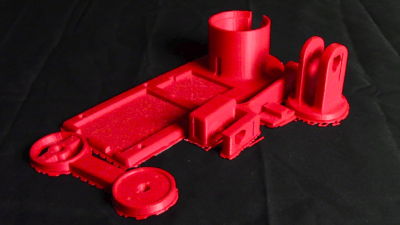
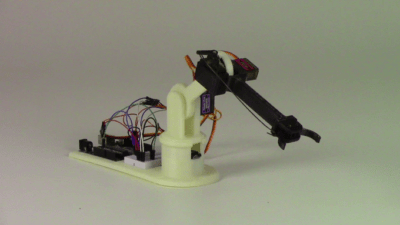
Boise, ID – Slant Robotics has launched a Kickstarter campaign for a 3D printed robot arm, LittleArm. LittleArm is low cost kit for teaching engineering and robotics to students in STEM courses.


The LittleArm began as a weekend project for Slant Robotics founder, Gabe Bentz. “I didn’t want to pay the 100-plus dollars for an existing arm kit,” said Bentz, “So, I did a little design and let my 3D printer do the work.”

Bentz eventually showed his creation to colleagues and friends in the area. Many asked him to make them one. But when several STEM teachers expressed interest in the arm for their classrooms Bentz decided to turn the kit into a product, at Slant Robotics.

Thanks to rapid prototyping techniques the LittleArm was ready for production within just a few weeks. It utilizes high strength metal-geared microservos, and is controlled with a standard Arduino Uno allowing it be programmed using graphical software such as Blockly. When connected to a computer, Slant has created a simple graphical app which allows the arm to be trained to execute a set of motions.

The entire project is open-source, allowing anyone to download the 3D designs and software and build their own LittleArm.

At the time of this release, the LittleArm Kickstarter campaign has passed the halfway point, after being live for just 2 days. Over the next few months the team at Slant Robotics will be developing software and producing teaching materials so that students and teachers can easily use the LittleArm when it arrives.

About Slant Robotics

Slant Robotics is a startup located in Boise, ID. Its mission to to develop consumer robots for the home, school and business. The LittleArm is the fourth product that Slant has released.

BuWizz – The one brick to steer them all

BuWizz is a high performance LEGO® compatible remote control system and battery, seeking to raise $50,000 on Kickstarter. Why we made BuWizz? The original LEGO® Power Functions control system allows lesser speed, power and agility than users would like to have for their models. Created as an enhancement to the existing LEGO® remote control system, BuWizz is better than anything available on the market until now. Paired over Bluetooth with an iOS or Android device, BuWizz brick is made to control the motors and lights of LEGO® Trains and LEGO Technic models. Besides motors to power movement, BuWizz users will be able to add light effects and other special functions to their models.

While one BuWizz brick can control up to four motors or lights, several bricks can be controlled in parallel, from either one or more smart devices. Users can control a huge model with 8, 12 or even more motors and lights. It’s perfect for having fun, like racing against each other using several cars. One BuWizz brick inside the model replaces 3 LEGO components: a battery box and two infrared receivers, while only occupying the space of two receivers.

Connected inside a LEGO model or train, BuWizz brick offers precise control and provides eight times more power than existing solutions. It operates in three speed modes, pushing any LEGO model to it’s limits in “Fast” mode. Until now, LEGO models were mostly limited to indoor use. With BuWizz they come alive, zoom around two times faster and are ready to defeat the most difficult outdoor terrains.

In a later announced stretch goal, BuWizz team will offer “Ludicrous” mode, the next generation of speed and power levels, which will dwarf even the currently highest-performance “Fast” mode.

Users will be able to write their own Apps to control BuWizz and integrate BuWizz into platforms of their choice, the communication protocol will be open.

The reason for success is design and clever engineering solutions, which made BuWizz powerful and simple to use. Several benefits of BuWizz are due to the embedded Li-ion battery, which provides power for hours of fun. BuWizz can be recharged with any Micro-USB charger. The App will alert users when power is running low. For extended play time, BuWizz can also be charged on the go, with a standard Powerbank charger.

The price of single brick will be $119. And shipping will begin in November.

WEBSITE – www.buwizz.com

http://www.buwizz.com/

THE KICKSTARTER CAMPAIGN  –

https://www.kickstarter.com/projects/973645257/789115000?token=eafeb608

SubPos Ranger: Indoor Positioning System

The SubPos Ranger is as an open source indoor positioning system to be used for robotics applications in the education and hobbyist markets. It has primarily been designed as a flexible radio frequency platform for experimenting and tinkering, that allows you to not only obtain positioning and perform distance measurements, it can also be used for passive motion detection as well as communication between embedded devices.

While there are many positioning systems on the market, the Ranger has been created to be extremely cost effective, easy to use and develop for. While other systems are usually locked down in one way or another, whether that be functionality or availability of source code, the Ranger is completely open and flexible. Perfect for the budding hobbyist to invent the next big thing.

The Ranger is fully operational and ready for manufacture, and a complete system can be had for $274AUD (~$210USD), which gives you 3D positioning in a room, as well as a receiver to output the position. Once set up, the system can give up to +-10cm of accuracy. Other options are also available to experiment with too, such as a cheaper option for two nodes to perform distance measurements and motion detection, or a Wi-Fi support add-on.

Key Features:
•        Supports 2D and 3D Positioning – not just x and y, but z also.
•        2.4GHz ISM Spectrum – supported worldwide.
•        Standards Compliant Hardware – supports 802.15.4 and can also utilise Zigbee or 6LoWPAN communication protocols.
•        Reconfigurable RF Chipset – enables many different 2.4GHz ISM applications.
•        Firmware Updates over USB – no need for any extra programming hardware.
•        Open Source Hardware and Software – hack, repurpose and play to your heart’s content.
•        Modular Design – the Ranger allow all sorts of connectivity options. You can connect it to anything such as a Raspberry Pi via USB or GPIO, Arduino or to your smartphone via Wi-Fi.
•        Low Level Raw Data and Parameters – access to all low level measurement data and parameter tweaks are available to discover interesting new applications (such as motion detection).
•        Node Position Calibration – get the position of nodes automatically; no manual fixed node measurements required.
•        9-Axis Accelerometer – the client expansion board contains a 9 axis accelerometer for increased positioning accuracy.

Board Image – https://cdn.hackaday.io/images/7007401465041329447.jpg
Client Image – https://cdn.hackaday.io/images/3158211465041337828.jpg